How YouTube ads pricing works
Every YouTube ad is bought in Google Ads. You pick a campaign goal, a daily or total budget and a bid strategy, and Google runs an auction each time your ad could be shown. With CPV bidding you never pay more than your maximum bid. You often pay less, because the price depends on the ads you're competing with and on the quality of yours.
Google charges in one of two ways.
With cost per view (CPV) you pay for views and interactions. For in-stream ads, a view counts "when someone watches 30 seconds of your video ad (or until the end of the ad if it's shorter than 30 seconds) or interacts with the ad, whichever comes first" (Google Ads Help). If a viewer skips before that, you pay nothing.
With cost per 1,000 impressions (CPM), using Target CPM, you set how much you're willing to pay on average every thousand times your ad is shown. You pay for impressions, so skipped ads still cost money.
YouTube ad formats and how you pay
| Format | How you pay |
|---|---|
| Skippable in-stream | Per view (CPV), or per 1,000 impressions with Target CPM and conversion bidding |
| Non-skippable in-stream (15 to 60 s, depending on the campaign subtype) | Per 1,000 impressions (Target CPM) |
| Bumper (6 s) | Per 1,000 impressions (Target CPM) |
| In-feed (search results, home feed) | When someone clicks the thumbnail or watches 10 seconds of autoplay |
| Shorts ads | When someone watches 10 seconds or interacts with the ad |
| Masthead (top of the YouTube home page) | Reserved in advance through Google sales |
Billing rules for in-stream, in-feed and Shorts views are in Google Ads Help. Small businesses usually start with skippable in-stream and in-feed ads, since you only pay for people who chose to keep watching or clicked.
How much YouTube ads cost per view in 2026
Published numbers disagree. WebFX's 2026 benchmark report puts the cost per view at $0.10–$0.30, and in-feed (discovery) ads lower, at around $0.05–$0.15 (WebFX). The report doesn't say what period the data covers. On its pricing page, WebFX cites a survey of 270 marketers in which the most common answer was $0.11–$0.40 per view (WebFX pricing). For impression-based buying, LocalIQ puts CPM at $4–$10 (LocalIQ). These are agency estimates, not Google figures, and we checked them on November 24, 2026.
Use any benchmark as a rough range. Your own price goes up or down with these factors:
| Factor | Effect on price |
|---|---|
| Country | Audiences in the US, UK, Canada and Australia are among the most contested |
| Audience | Narrow, high-value audiences such as business owners or in-market buyers cost more |
| Industry | Finance, legal and health attract more advertisers |
| Ad quality | Ads people watch and click win auctions at lower prices |
| Season | The retail months before the holidays are usually busier |
YouTube ads budget for a small business: how much to spend per month
Google has no minimum spend for YouTube ads, but a budget that's too small never collects enough data to show you which video works. For Demand Gen campaigns with a target cost per conversion, Google recommends a daily budget of at least 10 times that target and about 50 conversions for the campaign to learn (Google Ads Help). Size your test from what a customer is worth to you, not from a round number.
A simple YouTube ads cost calculator:
- Budget ÷ cost per view = views.
- Views × click rate = visits.
- Visits × conversion rate = leads.
- Budget ÷ leads = cost per lead.
Here's an example with made-up numbers, not benchmarks. A $1,000 test at $0.15 per view buys about 6,700 views. At a 1% click rate that's 67 visits. If 10% of visitors leave a request, you get about 7 leads at roughly $150 each. If a client is worth $2,000 to you, scale that test. If a client is worth $200, change the ad, the offer or the audience first.
Three budgets side by side, with the same made-up rates ($0.15 per view, 1% click rate, 10% of visitors leave a request):
| Monthly test budget | Views | Visits | Leads | Cost per lead |
|---|---|---|---|---|
| $600 | about 4,000 | 40 | 4 | about $150 |
| $1,500 | about 10,000 | 100 | 10 | about $150 |
| $3,000 | about 20,000 | 200 | 20 | about $150 |
A bigger budget brings more leads at the same rates, so you reach a reliable comparison between ads sooner. In real campaigns the rates change as Google learns, which is why the next step is a staged test.
We run tests in stages:
| Stage | What happens | Length |
|---|---|---|
| Test | 2–3 video ads, 2–3 audiences, tracking on every link | 4–6 weeks |
| Optimize | Turn off what brings no leads, move the budget to what does | 1–2 months |
| Scale | Raise the budget on the ads with the lowest cost per sale | Ongoing |
Send us your product, market and rough budget on WhatsApp. We'll reply with a test plan, an expected cost per lead and our management fee.
Ask on WhatsAppWhy you should track cost per sale, not cost per view
Two ads can cost the same per view while one brings customers and the other brings nothing. The difference sits in the video and in what happens after the click.
Viewers can skip after 5 seconds, so the ad has to name the problem and the result right away. Then people need a reason to act now: a free audit, a sample, a demo or a discount. And every link needs a UTM tag, with every lead going into one table, so you can see which ad brought each sale.
Once your tracking records leads and sales, you can switch from paying per view to bidding for conversions. With Target CPA you tell Google the average cost per conversion you're aiming for. With Maximize conversions, Google spends your budget to get as many conversions as it can (Google Ads bidding basics). Both need working conversion tracking, so set that up during the test.
We look at cost per lead and cost per sale every week and change the ads based on them.
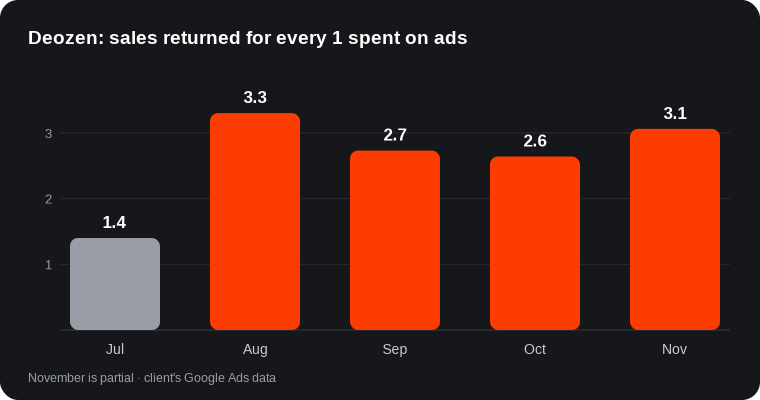
Here's what that looked like for Deozen, a deodorant cream brand. We ran 15 videos, mostly Shorts, as ads through Google Ads (Performance Max and Demand Gen campaigns), with a UTM tag on every video. According to the client's Google Ads report, from July to November 2026 the ads brought 313 orders. In the first month, while the campaigns were still learning, every 1 spent returned 1.4 in sales. In the following months it was between 2.6 and 3.3, and about 2.6 over the whole period (case studies).
We give a guarantee on paid YouTube ads: if the money you put into ads hasn't paid off within 3 months, we run your ads for the next month for free. The ad budget is always paid to Google separately.
YouTube ads management: who runs your campaigns and how fees work
You can run YouTube ads yourself in Google Ads. You'll need video ads built around the first 5 seconds, conversion tracking, audience setup and weekly optimization. Many businesses hand this to a specialist or an agency.
The agency fee is separate from the ad budget you pay to Google. Agencies usually charge a fixed monthly fee or a share of ad spend. WebFX, for example, publishes management fees from $750 a month, with larger packages at $975 or 15% and $4,500 or 12% of ad spend (WebFX pricing). Our YouTube ads management starts at $700 a month, depending on the size of the project, and the ad budget is paid to Google on top. We work out the exact fee and budget with you on a call, based on your market, your product and how many videos you need. See our services and pricing.
How much the video ad itself costs
The ad budget buys views, but someone still has to make the video. A test can start with footage shot on a phone: what matters most is that the first 5 seconds name the problem and the result. Once you know which message sells, it's worth paying for better production. Our editing package is $1,000 a month for 5 long videos plus Shorts cut from each, and the best of them can run as ads.
Before you hire anyone to manage YouTube ads, ask them how they'll track leads and sales (views alone don't count), who makes the video ads and how many versions they'll test, and what they'll report every week and change based on it.
Ads and an organic channel together
Ads bring data and leads fast. An organic YouTube channel builds trust and keeps getting views from search for years. Many businesses combine the two: the best videos from the channel become ads, and the ads bring subscribers who watch the next videos. One of our clients, a knife shop, grew its channel from zero into its main sales channel, with $74,000 in sales in one month (case studies). If you don't have a channel yet, start with a $27 channel review or book a call.
Tell me about your business and I'll show you how YouTube can bring you leads. The call is free.
Book a callFAQ
How much do YouTube ads cost for 1,000 views?
At WebFX's 2026 benchmark of $0.10–$0.30 per view, 1,000 views would cost $100–$300. Prices vary by country, audience and industry. A short test in your own account gives you the real number.
Do I pay if someone skips my ad?
Not with CPV bidding. You pay only when someone watches 30 seconds (or the whole ad if it's shorter) or interacts with it. With Target CPM, bumper and non-skippable ads you pay per 1,000 impressions, so skipped impressions count.
What is the minimum budget for YouTube ads?
Google sets no minimum. Plan a test budget big enough to bring the leads you need to compare ads, using the calculator above with your own cost per view and conversion rate.
Is CPV or CPM better?
For most small businesses CPV is the safer start, because you pay only for people who watched 30 seconds or interacted. CPM suits short non-skippable and bumper ads when you want as many people as possible to see a message. Once you track sales, test conversion bidding.
How long until I see results?
Plan 4–6 weeks for the first test, as Google recommends for Demand Gen tests (Google Ads Help). That's usually enough to see which video and audience bring leads, and then 1–2 months of optimization before you scale.
Can I run YouTube ads with a phone video?
Yes. For a first test, a clear phone video with a strong opening is enough to learn which message brings leads. Better production makes sense after you know which message sells.
Are YouTube ads worth it for a small business?
Yes, if the ad has a clear offer and you track leads and sales. Without tracking you only see views and can't tell whether the money paid off.
How much does YouTube ads management cost?
With us it starts at $700 a month, depending on the size of the project. The ad budget is paid to Google separately. Other agencies charge a fixed fee or a share of ad spend, as in the WebFX example above.
Is there a guarantee on YouTube ads?
For paid YouTube ads, yes: if the money you put into ads hasn't paid off within 3 months, we run your ads for the next month for free. The ad budget is paid to Google separately.

10+ years on YouTube. Runs his own channel with 531K subscribers; client channels have 171M views. Launched Nozhemania's YouTube channel from zero: in one month it brought $74,000 in sales.
How we write: we check facts against the sources we link, prices come from our published rates, client results from their own reports.